
On the premise of the interface
by Anisha Baid
“I don’t know why we call it a mouse. Sometimes I apologize it started that way and we never did change it.” – Douglas Engelbart, Mother of all Demos, 1968
An ongoing inventory of metaphors that have migrated from everyday life into the language of computing. Click here to add to the list.
The term interface finds its origin in nineteenth-century fluid dynamics, where it was used to describe “the shared boundary where two different types of fluids, or a fluid and a solid, meet.”1 In garment making, interfacing refers to material fused to the unseen side of fabric to make it more rigid. In both cases, the interface signifies a zone of encounter: a place where separate materials meet, generating new forms through their joining.
The landscape of interface design is populated with metaphoric images, borrowed meanings that eventually overwrite their origins. So we arrive at surfing the web as if it were an ocean, our computers the pleasant beach from which to paddle out. And in the same moment, our computers are terminals, ends of the line.
The most obvious illustration of this is the metaphor of the cloud. To the average user, the cloud is somewhere above, physically removed from the stuff and grime of this world, a trope that popular science fiction often activates. In contemporary use, however, the cloud operates less as spectacle and more as infrastructure, an ambient condition that recedes into the background, concealing its material dependencies: the rare earth minerals, the vast data centres. Alexander Galloway calls this the “interface effect,”2 a condition where digital systems don’t just mediate reality but remake the very terms of its existence. Jan Distelmeyer extends this further in saying that “Interfaces carry, in every sense of the word, the global computerization of living conditions.”3 These virtual windows exert behavioural, emotional and often financial control over a public who use them in every aspect of life, from work, to leisure, to political representation.
It feels as though it might be too late to say things in this register, to say that long ago, perhaps power only existed as an embodied idea, that a living thing had power which was married to some kind of agency. The laptop I am writing on now has low power and needs to be plugged in soon. Every morning, I power it on, imbuing its body with this notion of livingness; sometimes it crashes, overcome with activity, and tragically, sometimes it dies. And yet it can also be powered up again, rebooted, its memory erased, the machine cycling through states that we can only describe in the language of living things, because we have no other language ready.
We know that the web does not involve spiders and that web crawlers are not computerized critters creeping across tech offices. We also know that a mouse is not a rat. Every metaphor not taken is a reminder that the ones we have were chosen, and that every choice carries with it a set of assumptions about the world, about who works, how they move, what they already know.
THE CURSOR
Before it was a tilted arrow on every computer screen, the cursor was a mechanical sliding tool used for measuring dynamic distances. Going into the history of the word gives us this definition from the 16th century:
Cursor noun Middle English, denoting a runner or running messenger, from Latin, ‘runner’, from curs- (see cursive).
The idea of running or movement is central to the cursor’s character. Coursing through the interface, the shapeshifting pointer is embodied with purpose and action. This purpose usually originates in the mind of the single user controlling it, but may vary, it might be a remote user accessing another person’s computer, in which case there are two cursor characters running on the screen. There also exists the possibility of a programmed cursor, or an AI cursor, moving and performing tasks of its own accord. The cursor is the point of transference of the computer user’s intention into a virtual character through which the task is carried out through two processes, navigation and selection.
In his thesis4 on computers being ‘invocational media’ as opposed to mere digital or ‘interactive’ media, Chris Chesher points out that a computer command also comes with a measure of uncertainty, the computer might crash, bring up unexpected results, or take unexpectedly long to complete the task. This wait and uncertainty is part of what gives computers an ‘invocational’ stance, where the user doesn’t merely switch on a tool (like an electric fan or toaster) but requests the retrieval and processing of things unknown to them, similar to invoking a ghost or deity. The cursor is the symbolic tool through which these invocations are conducted: quite literally, an interface between the human will and the computer’s potential.
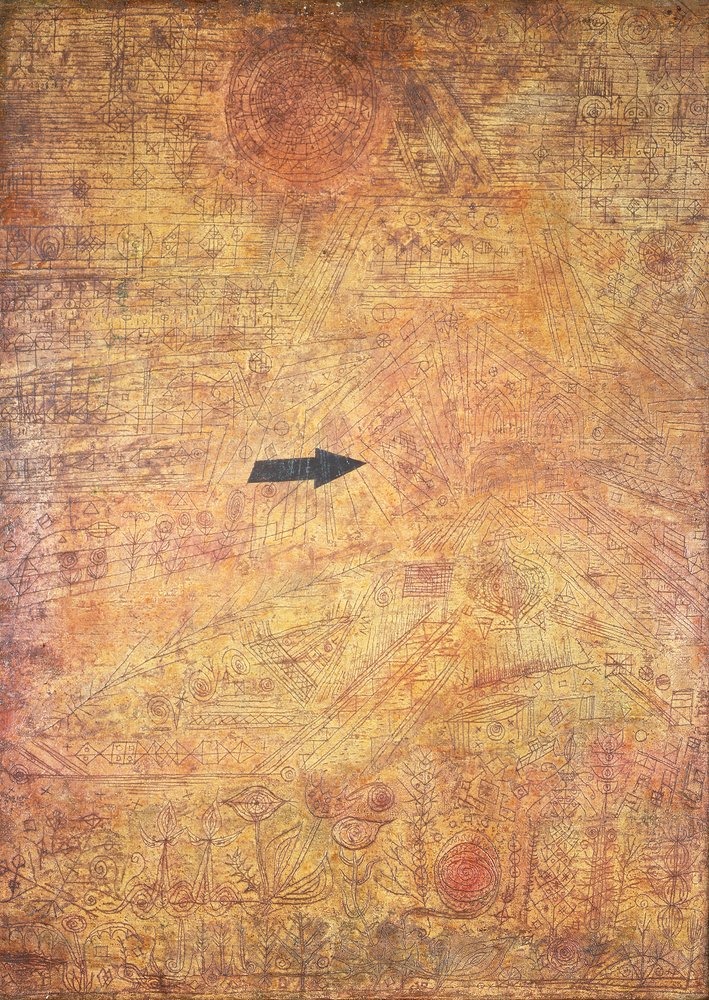
Paul Klee, Arrow in the Garden, 1929
While the cursor takes many shapes across various operating systems, it is most often manifested as a tilted arrow. Originating in the bow and arrow, a weapon used for shooting across long distances to a selected target, the arrow has become a ubiquitous symbol of direction through cartography, scientific illustration, and graphic design. Paul Klee, in his own artistic inquiry (documented in his Pedagogical Sketchbook)5 investigated the arrow as depicting form in motion. Describing it as a contrast between power and prostration, he wrote: “half winged, half imprisoned, this is man!”
The arrow is an almost universal representation of direction, simultaneously acting as the sign and the signified. Fingerposts, directional arrows placed at crossroads originating in the UK and Ireland around the 1600s, illustrated direction through the literal signifier of the hand. The pointing finger as symbol dates back to medieval Europe, where it was significant in the history of publishing. Early handwritten manuscripts, and later mass-produced texts, were annotated using the symbol of a pointing finger, or Manicule (also called index) in the margins.
The manicule stays alive in contemporary times through the pointing hand cursor, appearing when one needs to select or move objects, the pixelated hand with an extended index finger is a reminder that digital comes from our five digits.

Manicule from Corpus Iuris Civilis (1478)
COMPUTERS AS THEATRE
The first prototypes of a computer cursor and mouse were developed at the Stanford Research Institute by Douglas Engelbart and his team. Officially named the “X-Y position indicator for a display system,” Engelbart’s proto-mouse moved a zipping dot on the computer display along the vertical and horizontal axes.

Standford Research Institute staff members preparing for Douglas Engelbart’s demonstration at the Fall Joint Computer Conference,
San Francisco, December 9, 1968 – later known as “The Mother of All Demos.” Photo: SRI International.
This paradigm transformed the computer from a command-and-prompt machine into a representation machine that generated a plethora of visual landscapes to be navigated by a central character, the cursor. From this dot pointer, the cursor migrated to the desktop: an office interface charted by an arrow that could dive into folders and sub-folders to retrieve information. The desktop metaphor was conceived at XEROX, where computer memory locations were named files and folders, and application interfaces were called windows. It is somewhat significant that the chosen metaphor was the office, not a room, a cave, or a home. Microsoft’s experimental MS Bob briefly attempted a home metaphor, with spaces like a living room and study, but the world migrated toward more minimal, abstract interfaces, these nonetheless continued to rely heavily on metaphoric representation, a strategy called Skeuomorphism, championed by the waste-paper basket called Recycle Bin sitting on every computer today.
Brenda Laurel writes about the interface and its devices as “a virtual world… populated by agents, both human and computer-generated, and other elements of the representational context (windows, teacups, desktops, or what-have-you).”6 But unlike theatre, this stage has real consequences: documents generated on screen materialise into contracts, diagnoses, verdicts, and war commands. The fiction and the fact do not occupy separate planes, they run on the same screen, often at the same time. A spreadsheet sits beneath a video call, beneath a browser with seventeen tabs, all beneath a wallpaper of the milky way galaxy.
This layered viewing produces a sense of placelessness, or every-placeness, where distances collapse and locations exist only in relation to what is one click away. The key vehicle for collapsing this apparent distance is the free-moving cursor. Jumping from one location to another, it flattens the illusion of depth created through these stacks. A default shadow accompanying all cursors facilitates this illusion, as does an optional trailing image as it moves. The direct manipulation of the cursor through the hand establishes and embodies control, as if one’s own fingers were moving across a virtual world.
The arrow, an inert sign, carries within it the potential of virtual touch, collapsing distance and time to come into contact with its object of attention. The touchscreen is a direct manifestation of this. With the removal of the arrowhead as an onscreen symbol, virtual touch returns to a pseudo-embodied state, where the finger touches the screen and the various depths of its image. Yet this return is twice removed: the gesture of touch becomes an invisible representation of the very thing it once symbolised. Walter Benjamin described gestures as “simultaneously both sign and action, that is, closed and open form.”7 The cursor inhabits exactly this condition, owned equally by the interface and its human user, the former imbuing it with latent powers of action, the latter providing its life through movement.
CLICK – SOUND, GESTURE, TOUCH

Screenshot of my cursor, operated by my nose, touching live feed from the lunar surface.
On the computer, the click may have emerged from the sound of the mouse button, initially a single switch-like button. Every selection made using the mouse and cursor would emit a corresponding mechanical ‘click’. Vilem Flusser, in his essay “Why Do Typewriters Go ‘Click’” investigates its titular question through a philosophical musing on the nature of human-machine interactions. “Why do machines stutter?” he asks, and goes on to answer himself: “Because everything there is in the world (and the whole world itself) stutters.”8 For Flusser, this stutter is not a flaw but a condition, the machine’s way of breaking continuous human intention into discrete, countable units of action. The click is exactly this: the moment where the flowing gesture of the hand is interrupted, registered, and converted into a command.
As mouse technology developed and its buttons became more ergonomic and silent, the click began to be replicated as a digital sound that would play upon selection. Different kinds of ‘clicks’ or selections would emit variations of this click sound. In this sense, sound became another dimension of drawing attention and generating meaning within the interface, allowing users to gauge the effects of their actions, or notifying them of illegal or dangerous actions on the computer. A click is a single unit of interface interaction and has gradually become the currency of the internet: clickbait and clickability drive global content creation markets running on ad revenue, and in situations of remote labour, clicks are measured as an index of work. The stutter Flusser described has become the basic unit of an economy.
If pointing is analogous to aiming and shooting an arrow, clicking can be ascribed to its moment of contact with the target. With the disappearance of the cursor, as interfaces transform into touchscreen surfaces, the click also becomes mute, shedding its representational reference to the real world. Sensorial reminders of interface interaction disappear to present a seamless experience of the digital, one where clicks are recorded but not heard
POWER POINTING
The stage of the interface holds many political deliberations of the real world, and the most visible of these is that within the office, a workplace transformed almost entirely by the rise of the personal computer. Through varied work cultures and geographies, the informal campuses of Silicon Valley, the glass-walled buildings of banks and professional firms, the shared spaces of startups, the home desks of individual creators, the computer creates one normative mode of work – a worker sitting at a terminal, hands on a keyboard, one hand on a mouse. In some ways the desktop metaphor is externalized, creating the office that the interface narrative demands. The popularity of the laptop has since broken this rigidity somewhat, the desk becomes a more variable surface, the chair replaced by any place one can sit. While this signals a departure from normative computer working paradigms, it creates a new mode of “always at work” work. As the lines dividing the computer and its user continue to blur, so do our mental images of what the computer even is.

Amongst Douglas Engelbart’s experiments with the mouse – A knee-operated pointing device
It is endlessly amusing to imagine alternatives: the knee-operated mouse from Engelbart’s early experiments, a stick attached to all our desks, rigged with sensors and motors, and all us computer workers, champions of break-dancing. But these are not merely comic counterfactuals. Every metaphor not taken is a reminder that the ones we have were chosen, and that every choice carries with it a set of assumptions about the world, about who works, how they move, what they already know.
Novel modes of representation are bound up with the activity of reference. The hands of cavemen become tools, tools become power, power becomes legitimised, the individual is born and returns to her hand. Raising it to declare her presence, pointing to transcend it, clicking to travel, touching to teleport.
References
- Hookway, Branden. Interface. Cambridge: MIT Press, 2014. https://direct.mit.edu/books/book/3047/Interface ↩︎
- Galloway, Alexander R. The Interface Effect. Cambridge: Polity Press, 2012. https://www.politybooks.com/bookdetail?book_slug=the-interface-effect–9780745662527 ↩︎
- Distelmeyer, Jan. “Drawing Connections.” Interface Critique, vol. 1, 2018. https://interfacecritique.net/journal/volume-1/distelmeyer-drawing-connections/ ↩︎
- Chesher, Chris. “Invocational Media.” PhD thesis, Macquarie University, 2001. ↩︎
- Klee, Paul. Pedagogical Sketchbook. Translated by Sibyl Moholy-Nagy. New York: Frederick A. Praeger, 1953. ↩︎
- Laurel, Brenda. Computers as Theatre. 2nd ed. Upper Saddle River: Addison-Wesley, 2014. ↩︎
- Benjamin, Walter. Understanding Brecht. Translated by Anna Bostock. London: Verso, 1998. ↩︎
- Flusser, Vilem. “Why Do Typewriters Go ‘Click’?” In The Shape of Things: A Philosophy of Design. London: Reaktion Books, 1999. https://www.broodthaers.us/MEDIA/00963.pdf ↩︎
About the Author / Guest Editor:
Anisha Baid is an artist and writer based in Bangalore. Through performances, guided meditations and static objects, her work attempts to poke at the flat-scapes of the computer screen to decode computer labour through the interface – a technological tool that has converted most spaces of work into image space.Her work has been shown in international solo exhibitions including at Pittsburgh Cultural Trust, as well as at Technical Collections, Dresden (2020), GIBCA, Goteborg, Sweden and Landskrona Foto Museum, Sweden. She has been supported by various grants and awards including from the Frank Ratchye Studio for Creative Inquiry, Inlaks Foundation, the India Foundation for the Arts, the Goethe Institut, as well as the Arts and Humanities Research Council, and Bluecoat in the UK.
This issue of Purée Mag was made possible through the support of the Generator Cooperative Art Production Fund, 2025-26.