
by Somnath Bhatt
The past is always slightly out of place. It appears where it should not, survives in the wrong forms, arrives carrying contexts that no longer fit the world of now. Objects and images from the past do not arrive intact or contained. They come to us carrying more than they show and declare less than we might hope to know. What we encounter in them often sits at odds with what they were meant to be, or what we expect to find. The past already contains its own counter-memory, dormant pressures and misaligned forces that persist inside whatever trace version of the past that survives. The past is a leaking entity. It behaves more like a tensile surface, stretching, recoiling, refusing equilibrium, pulling these objects into unexpected relations. Perhaps this is how the present breathes, by constantly being stretched. Like a pressure wound, the constant proximity of an object or image from the past can become a field of heightened sensitivity, where attention gathers and does not easily disperse. To look is already to imagine. The act of seeing the past can show us how close, actually, another reality is to our own. And sometimes closer than we want it to be. What does not fit our current frameworks is not therefore lost to us; it may be the part still available for us to gather.

Aerial view of the Man Mound in Sauk County, Wisconsin built originally by Late Woodland Native Americans (c. 750–1200 CE), from google image search
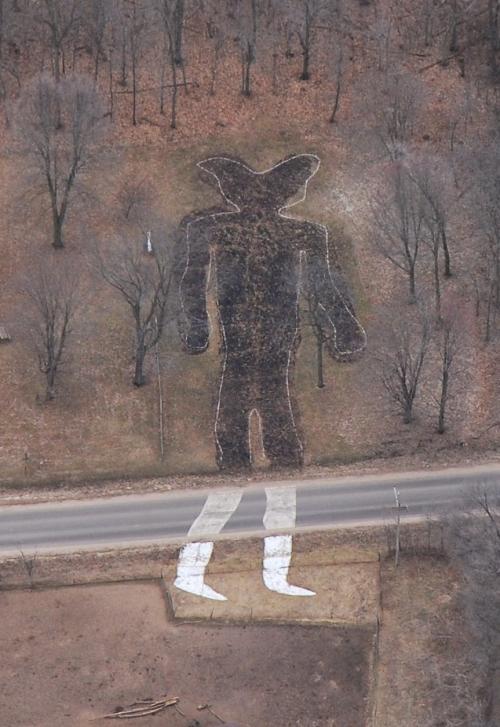
Consider the earthwork figure known as the Baraboo Man Mound. From an aerial perspective, it appears to be a humanoid outline inscribed onto the land. A road cuts through the figure, bisecting it. The intervention is infrastructural, banal, modern. But what we notice is that, despite this, a solution also already exists: the figure’s white calves have been painted over the road, and its feet are similarly filled in on the yellow grass beyond. The figure persists not as an intact object but as a composite: earth, absence, repair. Defeat and victory of form, both. It occupies a temporal density that resists reduction. What we encounter is not an artifact but a convergence of a long chain of arbitrary events just simply lining up. Beyond anything art-like. It exceeds intention because it is constituted through successive, discontinuous acts. It remains only because a larger history happened to arrange itself in this particular way. And yet someone painted the calves. The figure was given its legs back, even where the road insisted it shouldn’t have them. The past, here, is something stubborn and slightly funny — a thing we keep deciding to let walk.
People, too, reach us as composites: pieced together from the parts of them that the present found legible. Kathiyawadi poet Jhaverchand Meghani is widely remembered in Gujarat for preserving the valorous bardic traditions of the Charans, Gadhavis, and other communities of the Saurashtra region. Writing in Gujarati from 1921 until his death in 1947, Meghani made his most enduring contribution by capturing and sustaining the folk (talpadi/તળપદી) sensibility of Saurashtra. One such song, Mor Bani Thangat Kare, was used — oddly — by the Bollywood director Sanjay Leela Bhansali in the soundtrack of his film Ram-Leela.. He was also active in the Gandhian freedom struggle and faced prison time due to his involvement. Through his work in periodicals like Saurashtra and later Phulchhab, as well as in his Saurashtra ni Rasdhar series, he vividly chronicles rural life, oral storytelling, and everyday speech, all marked by a rhythmic, deeply local texture. One side of his persona leans toward a pastoral longing. In Chorano Pokar ચોરાનો પોકાર, he calls for the rebuilding of the broken Choro (ચોરો), the village square that once formed the center of collective life. Of Meghani, we remember much, but not all. To our contemporary eye, his body of work has unexpected offshoots.
As early as 1922, Meghani was translating and compiling texts on anti-imperialist struggles across Korea, Ireland, Hungary, Egypt, Indonesia, and China, producing works like Asia nu Kalank on Korea, Salagtu Ireland on the Irish struggle against Britain, Hungary No Taranhar on the freedom struggle in Hungary, Misr no Muktisangram on Egypt between 1922–1930. In 1946 Jay Indonesia, based on the Indonesian freedom struggle which his son Mahendra Meghani helped complete. Why did a poet so closely tied to rural memory and bardic tradition engage so deeply with distant political movements beyond India? Meghani seems to have understood, ahead of many, that empire and capital clutch their hands around populations in eerily similar ways despite geographical distances. To look only inward is never enough. To look at the foregone nostalgia of a functional village square, while new people-led coalitions are sprouting up across our neighboring lands. One had to keep one eye on the village, another on the world — and in that doubled vision, discover the possibility of solidarity between distant allies. This pull between the village square and the decolonial anti-imperialist world stage stretches the horizon of our contemporary understanding of the intellectual project.

Cover of the Gujarati book Dhwaj-Milap (ધ્વજ-મિલાપ); translated and edited by Jhaverchand Meghani, 2nd edition, published by Phulchhab Press on 20 September 1943.
In 1943, Meghani published a short book on the recent political history of China called Dhwaj-milap (ધ્વજ-મિલાપ), literally “Union of the Flags.” It was the sequel to another text, the more difficult-to-find Mahavir Padoshi (મહાવીર પાડોશી). Dhwaj-milap has a striking red and white striped cover which carries on it symbols of both the Communist Party and the Kuomintang. It narrates the history of China from 1936 onward, tracing what we now recognize as a temporary and improbable alignment between “the red-colored communists” (સામ્યવાદી/Samyavadi) and the “the white-colored nationalists” (રાષ્ટ્રવાદી /Rashtravadi). To assemble this account, he worked through translation, drawing from Red Star Over China by Edgar Snow and Mowrer in China. On its cover, a Mandarin slogan is supposed to read “ચીનના શાંતિમય એકીકરણ માટે મથો”. According to Meghani, this was a call for peaceful unification. In the introduction, Meghani centers the narrative on what he saw as a compelling historical moment: the temporary alliance between the Red Communist Army and the White Nationalist forces against Japanese invasion, now known as the Xi’an Incident. In 1936, amid rising anger toward Japan, Nationalist General Zhang Xueliang, working with Communist leader Zhou Enlai, detained Chiang Kai-shek and forced him to reconsider his strategy of prioritizing the defeat of communists over resisting Japan. This led to the formation of the Second United Front, bringing together opposing factions against a common enemy. Meghani is drawn to this unlikely convergence, where ideological divisions are set aside under pressure, and he reworks it for a Gujarati readership as part of a wider imagination of anti-imperial struggle worldwide.
Before he can witness the violent dissolution of this historic alignment, Meghani suddenly dies one morning in March 1947, at home in the village of Botad. What appears in his writing as a compelling union then hardens into one of the defining ideological rifts of the twentieth century. The same two flags that once appeared together on his cover are later set against each other across continents, drawn into the larger choreography of Cold War politics. The oddity of their earlier alignment becomes even more pronounced in hindsight. It was never stable, never meant to last. What Meghani captures is a moment when history briefly folded itself in on itself before snapping back into sharper lines of difference. What remains is not a coherent narrative but a trace, a contingent hope, a record of possibility.
To commemorate Meghani’s death, one of his contemporaries the bardic poet Dula Bhaya Kag says:
“મેઘાણીએ કબર ખોદી કાઢી, મૈયતોને ઉઠાવ્યા અને જીવાડ્યા. ધૂળમાં ખોવાઈ ગયેલા અને જુના માણસોને પોતાની કલમથી અમૃતજળ છાંટી બેઠા કર્યા. ખરેખર મેઘાણીએ ધૂળ ધોવાનું કામ કર્યું. જાતે ધૂળ ફાકીને આપણને સાચું સોનુ આપતા ગયા.”
“Meghani dug into the tomb and made the buried speak again, live again.” Here, Kag refers to folk literature, but Dhwaj-milap shows that what is excavated from the past never returns to us whole or uncomplicated. The poles themselves move, meanings invert, alignments dissolve. And a Gujarati audience remembers only one part: the folklorist Meghani but not the internationalist political actor. Meghani’s gift was to hold both registers at once: chronicling localized intensities while imagining geopolitical alliances. In this dis-remembering is also lost the inherent connection between the creation of art and the political imagination of the artist. Meghani is an example of someone who wanted to think across differences in the third world. For Meghani, awareness of difference or historical siloing need not be what divides us.
Memory, in this sense, is less a function of preservation than of selecting what fits the story we already believe. We only have room to remember what will neatly fit into our current version of reality. What endures does so because it intersects with structures of power that only allow certain versions of someone to be visible. Our canon formation may have domesticated some of Meghani’s literary sharpness by preserving the culturally “safe” parts while erasing the globally political ones. Does our memory somewhere depoliticize Meghani’s revolutionary potential by seeing him only as a chronicler of Gujarati heritage? The archive is not neutral; it is selective, contingent, uneasy. The internationalist Meghani is still there, in the pamphlets on Korea and Egypt and Indonesia, waiting in a register the present has not yet known how to read. The archive of the unfitting is also an archive of the unspent. The figures that travel down to us show a consistent incompleteness that speaks to the cultural and political frameworks of their time. But, through examining what persists in their efforts, we witness for ourselves the exact complexity of their real whole interests held open.
To be edited out of memory is one fate. To be shaped, from the beginning, by the hand of the thing you are trying to depict is another. Sometime in the 16th century in the Mughal court, the Hindu painter Bichitr (बिचित्र/بیچتر) constructs a tightly ordered visual record of the world around him. In the miniature Jahangir Preferring a Sufi Shaikh to Kings, Bichitr constructs a world where a radiantly haloed Emperor Jahangir sits on upon an hourglass throne, offering a book to a Sufi saint while James I of England and an unidentified Ottoman sultan wait below, all arranged in a precise hierarchy of attention and devotion. Quietly present in the lowest corner, we glimpse the painter himself, holding a miniature painting depicting himself bowing down next to two horses and an elephant.
Bichitr here works as a human image compositor, a fabulist who gathers anatopic figures of historical power into a single, carefully staged frame. He illustrates a suspended worldtime, a fictional moment that reflects the imagined harmony and authority of Mughal rule, a constructed reality into which he also places himself. His presence seems to say that those who build images are also folded into the strange orders that make those images possible. This insertion is not an assertion of autonomy so much as an index of constraint.
To read such an image is to confront the entanglement between beauty and power. Formal coherence here is underwritten by a patron determined to deploy every visual language his atelier could master. Bichitr’s personal mastery of European painting’s late Renaissance realism shows how he could selectively incorporate its techniques to reiterate the power of his sponsor.


Left: Self-portrait of Mughal court painter Bichitr; right: the name “Bichitr” inscribed in the handwriting of Emperor Shah Jahan.
Even the inscription of his name signals his relationship to the image. Amal-e Bīchitr was likely inscribed upon the image by Shah Jahan himself and seems less a credit than an attribution of a task. Bichitr’s name itself may be a corruption of the Sanskrit vīcitra (विचित्र), meaning variegated, many-colored, manifold, uncommon, odd, strange, or curious. Here, It feels less like the artist’s name and more a condition the artist inhabits. Through it, the hand that paints is already aligned with the hand that governs. Bichitr’s hands and eyes become a proxy for the emperor’s own, seeing and rendering the world as power wishes it to appear.
What reaches us from the past may be less a record of what was than a residue of what could pass: what moved cleanly through the channels of authority, where will, constraint, and invention briefly aligned. In such conditions, even a figure like Bichitr, working within narrow permissions, occupies a marginal yet persistent space: a painter not fully sovereign, yet not entirely erased. Present only in traces, even within the limited agency Bichitr may have possessed, as a painter, a storyteller, a servant rather than an auteur, he reaches out to us through a fraction of space, the smallest increments of brushstrokes, from the corners where he could still act and make himself remembered. Bichitr lingers at the edge of the official picture — not as resistance exactly, but as residue with a possible future.
It prompts the question of how much of what we come to see, value, and remember persists not by virtue of its independence, but because it permits power to circulate without friction—moving quietly through images that appear self-articulating, yet are already conditioned by the forces that sustain them. What presents itself as autonomous expression may in fact be a surface through which authority passes most effectively when it is least visible. Is memory a matter of proximity to power, or something more accidental and fragile?

Left: the Swanscombe handaxe (c. 400,000 years ago; Swanscombe, Kent, England); right: the West Tofts handaxe (c. 400,000–300,000 years ago; West Tofts, Norfolk, England).
Even at distances where intention can no longer be confirmed, the object itself can still speak. Sometimes more clearly than the ones close to us. These two Paleolithic handaxes were shaped around fossilized marine life, each carved to deliberately frame the organism at the center of the tool. Made during the Lower Paleolithic period — long before Homo sapiens reached the British Isles — made by archaic humans likely Homo heidelbergensis or early Neanderthals. The choice made by the maker feels intentional, even poetic. Yet the interpretation of this gesture ranges from projection to educated conjecture. However, despite what we cannot know, the object itself speaks to us clearly about the proximity between violence and beauty. Here, aesthetics and utility converge: the handaxe is both weapon and expression — sharp, painful, deeply personal. The handaxes embody a dual nature: the will to strike and the will to make meaning, even in stone. The edge holds beauty and pain in the same breath, a bound distinction.
Across these examples, images of the past arrive as partial constructs, shaped by the conditions of their survival and the schema of their interpretation. What they offer us is proximity without access, recognition without simplicity. Folded within them are their own shadow selves, displaced pressures and historical traces seeking to become present again. A field of forms that are, in the fullest sense, bichitr— odd, iridescent, irreducible. But this oddness is an instrument. The parts of the past that do not fit — Meghani’s pamphlets on China, the painted calves stitching a Late Woodland figure back across a county road, Bichitr’s self-portrait tucked into the corner of an imperial commission — are precisely the parts our inherited frameworks have not yet learned how to use. They sit awkwardly inside the stories we currently tell, and so they remain unspent. To attend to what is bichitr in the past is to refuse the memory that keeps Meghani a folklorist and forgets the internationalist, that keeps Bichitr a servant and forgets the storyteller in the corner. The archive holds more coalitions than the present has remembered how to want. We look back and see our own path changing — and begin to see, in the odd survivals of what came before, the outlines of solidarities we have yet to rebuild. Always a little out of place. We look back and see our own path changing.
About the Author
Somnath Bhatt is an artist, designer, and writer drawn to the force of the unseen, the unspoken and the unruly logics of myth. For him, form-making is an antenna—sending and receiving signals from just beyond perception, always reaching, never quite closing the gap. His pixel-driven language stages encounters between what we have already seen and what is still on its way. Somnath believes, “Old and new as conceptual categories belong to a realm that precedes language, residing in the vague yet potent space between what can be articulated and what can only be felt. Language merely grazes the surface of these experiences; the real force of oldness and newness is apprehended first as sensation.”
Bhatt’s recent solo exhibition includes Republic of Shadows, GALLERYSKE, New Delhi, his work has been shown at India Art Fair (New Delhi); Art Week Dubai; the ICA (London); Mécènes du Sud Montpellier-Sète; Acud Macht Neu (Berlin); Picture Room (New York City); ISA Gallery (Shanghai), Abrons art center (New York City) the New York Art Book Fair; and the Brooklyn Art Book Fair. His first solo exhibition was held in 2020 at ISA Gallery in Shanghai. Somnath has collaborated across disciplines spanning arts, culture, fashion, music, and editorial design, including Mitski, Nicolás Jaar, Troye Sivan, Pakistani pop-star Ali Sethi, HYEIN SEO, SSENSE, The New York Times, The New Yorker, and The Atlantic. Recently, Somnath finished an 80-foot mural at Wonder Cabinet, an interdisciplinary studio and cultural hub in Bethlehem, Palestine.
The artist lives and works between New York City and Ahmedabad.